
Race and Education
Season 1 Episode 103 | 26m 46sVideo has Closed Captions
Flatland takes a look at the need for education around race in schools.
School board races across the U.S. found themselves revolving around controversy over Critical Race Theory, a legal framework that studies the history of racism in American institutions. But across most K-12 curricula, the Flatland host D. Rashaan Gilmore invites KCPS teacher Tymia Morgan, race and equity coordinator PaKou Her, and Shawnee Mission School Board President Heather Ousley to discuss.
Problems playing video? | Closed Captioning Feedback
Problems playing video? | Closed Captioning Feedback
Flatland in Focus is a local public television program presented by Kansas City PBS
Local Support Provided by AARP Kansas City and the Health Forward Foundation
Race and Education
Season 1 Episode 103 | 26m 46sVideo has Closed Captions
School board races across the U.S. found themselves revolving around controversy over Critical Race Theory, a legal framework that studies the history of racism in American institutions. But across most K-12 curricula, the Flatland host D. Rashaan Gilmore invites KCPS teacher Tymia Morgan, race and equity coordinator PaKou Her, and Shawnee Mission School Board President Heather Ousley to discuss.
Problems playing video? | Closed Captioning Feedback
How to Watch Flatland in Focus
Flatland in Focus is available to stream on pbs.org and the free PBS App, available on iPhone, Apple TV, Android TV, Android smartphones, Amazon Fire TV, Amazon Fire Tablet, Roku, Samsung Smart TV, and Vizio.
More to Explore
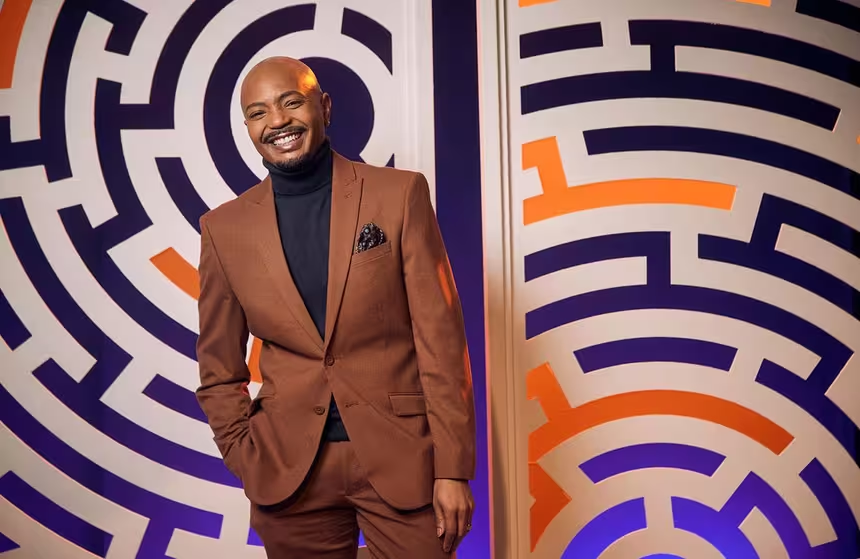
Meet host D. Rashaan Gilmore and read stories related to the topics featured each month on Flatland in Focus.Providing Support for PBS.org
Learn Moreabout PBS online sponsorship- Hi, I'm D. Rashaan Gilmore.
Welcome to "Flatland".
Every month we dig into one issue that's raising questions, causing tensions or has gone curiously unexplored in our area.
For this episode, we'll be talking about how we approach race and history in our classrooms.
(upbeat music) School board meetings and political races across the nation have become hot with the topic of race in the classroom.
How it's taught or if it should even be talked about at all.
Many of these debates circle back to the topic of critical race theory, a graduate level curriculum that examines the application of law and systems around race.
But surveys show that 96% of K-12 schools across the nation do not teach critical race theory in their curriculum.
Let's take a look at how educators, parents and students are navigating this complicated space.
(gentle music) - [Carmaletta] The Cleaver plan laid out the plans and the funding for '18 combined for this district.
Congressman Cleaver was a young man once.
I tell him, I tell kids that and he said, "Dr. Carma, that's not funny."
Leona Pouncey Thurman was the first black woman to practice law.
Sarah Rector at one point was the richest black woman in the country.
This is the home of a formerly enslaved woman, Lucy.
(gentle piano music) All of these people, all of these places did have community remembrance projects.
'Cause they understand the importance of doing this, of acknowledging this happened and now they can heal.
Before I came here, I was a teacher.
Every single semester for 28 years in my African-American studies class a student would say, "Why didn't we learn about this in high school?"
- [Narrator] 25 States have introduced bills or taken other steps to restrict education on racism and bias.
- [Man] We are about teaching history in an objective way that is not represented as America is systemically racist.
- [Man 1] Critical race theory is racist.
- I will do everything I possibly can to fight to the bitter end until you prove to me that you are not teaching my children that they are racist just because they're white.
- Could indoctrinating our children via CRT, America is not racist.
- This hateful divisive material teaches teachers to hate America and ultimately break every person down into privileged and the oppressed.
This is the exact definition of critical race theory.
It needs to be stopped immediately.
And parents need assurances that this hateful, divisive material will not be built into our curriculum.
(audience applauding) - When you're talking about critical race theory, so it's something that really only researchers are using.
The 1960s, all these laws were passed during the civil rights movement in hopes to bring greater equality for people of color, in particular black people.
But then by the time the 1970s rolled around and we saw that, man, it doesn't really seem like it's gotten that much better.
What is going on?
When Crenshaw and Bell were looking at the realities of the legal system and laws and we're saying the equity is not there.
The equality is not there, what is happening?
- Basically, if a system is created by people who are deeply racist against another group, then that institution will reflect the racism of the people who created it.
This is all higher level thinking that people debate in graduate school classrooms.
And so the idea that someone is teaching anything close to that at the elementary school level or the middle school level or even a high school level is ludicrous.
What people who are protesting about critical race theory are really protesting is the lessons about historic racism in America's past.
And the discussion of systemic racism in America today.
When George Floyd was killed, the debate over the effect of systemic racism and policing was essentially over.
So people who are trying to stop America from facing the legacy of its systemic racism had to find a new way to push back.
What they're trying to do is make teachers afraid to talk about America's history of racism.
And make teachers afraid of talking about how systemic racism works in America today.
- [PaKou] And in the end, I think what's happened is that people have personalized this entire conversation about race.
When you critique stuff that people revere like the story of Columbus sailing here on the Ocean Blue.
Or like the fact that anybody can come here and build themselves up on the basis of meritocracy.
When you begin to unravel that, you don't just unravel a historical narrative but you're unraveling people's sense of themselves.
But part of the political rhetoric has been to twist a story about white history and the dominance of white history in this country.
In order to say all white people are bad.
That's not what it means at all.
- [Tina] What's happened is the misinformation about CRT has caused people to think any teaching about race at all is CRT.
When you're talking about diversity, equity and inclusion and making sure that kids feel like they're a part of the curriculum.
Feel like they see themselves represented in history.
Feel like they see people like them making contributions to humanity and making the world a better place, to empowering them in their own agency.
Critical race theorists might say that's really good work.
That could start to really tackle some of these issues we're looking at.
But that doesn't mean that those things are rooted in CRT.
- [Jackie] And I wish the parents that are so vocal about it really truly understood what this work is about.
I loved English but I always struggled while I was going through those classes, where is my story?
And I felt so defeated.
I didn't want my students to ever feel that way.
That they would be free to read stories that reflected their experience.
It's all literature written by Latinos who have lived here in the United States, have had some experience here in the United States, were exiles here in the United States.
This is American literature.
Most of them are seniors.
They're 18 years old about to graduate and they haven't read anything written by a Latino.
They've never had a Latino teacher ever before.
A lot of times, it's not even taught at all.
We're still doing English, you're still learning about history but it's just a different story.
It's another side to it.
- [PaKou] If you're a young black person who has a family with history of chattel slavery or if you're a young indigenous person whose tribe or nation was obliterated in the process of colonization.
If you're a young Latino or Latina or Latinx person whose family is struggling with border issues.
When we erase those stories, we're not just erasing the story in history, we're erasing people and that's huge.
You cannot live in a world that's ruled by race and not have absorbed some of that in some way.
Regardless if you're a person of color or a white person, we're all swimming in it.
- [Tina] If we erase all hints of racism from the curriculum, that doesn't mean it goes away.
It means we give it a past 'cause there's this thing called the null curriculum, which means it's not written down anywhere but everybody's learning it.
- Three incidents in three weeks.
Suburban schools across the Metro are investigating racially charged situations on and off school grounds.
- [Reporter] And this all began last Wednesday when students at Park Hill South High school passed around a petition to reinstate slavery.
- [Superintendent] And these kids think they're being funny.
It's not funny, it's hurtful but maybe they don't understand that.
- And the fact of the matter is if we don't talk about racism in school, kids won't have a safe place to grapple with some of these issues.
And be provided with information and with sources to be able to find answers to their questions.
- I have a lot of well-meaning people who say, "I'm colorblind" and I tell them, "Please, don't be."
Because if you're colorblind, the first color to disappear is black.
And then you don't see me.
If you don't see me as a black woman, you have missed the essence of who I am.
So don't be colorblind.
Accepted it, acknowledge it and then think about it.
- It's really a space to have those conversations so that you can literally grow from it.
I'll have students that break down in tears because this is so heavy for them.
But just like any struggle, you get stronger from it.
- Our public schools are meant to help all kids and even people that are running for school board on anti-CRT agenda when they don't even know what it is, they still have a responsibility to all of these students.
- Welcome back for the discussion portion of our program.
With us in the studio today is PaKou Her, racial equity and social justice trainer and parent.
Heather Ousley, head of the Shawnee Mission School Board.
And Tymia Morgan, Central High School teacher.
PaKou, I'd like to start with you and ask you to do something that so many have failed to do.
So this is a little bit of an unfair question, but what is critical race theory?
- So just so folks know, critical race theory is actually an academic and legal study of the ways in which racism is codified and built into the systems of our society.
It is not typically everyday conversation that people are having.
It's not the same kind of conversation as diversity or equality.
Those are very different kinds of conversations and critical race theory is about 40 years old in academic speak.
So it's not super new term, even though folks may be hearing it for the first time really in the last 12 to 20 months.
And I think what has happened is people are in fact contemplating conversations about diversity and equality with conversations that they think are happening on critical race theory.
And I sort of joke with people, I suspect that most people who are pushing back on critical race theory actually don't know what it is.
But have heard talking points or rhetoric and are in a political and racial social climate right now in which race is divisive, historically not any more divisive than it's been before.
But it is front and center and at the heart of a lot of people's conversations.
And there have been a few who've been able to create the narrative around critical race theory when people are actually trying to talk about equity, diversity and fair treatment and just treatment based on race.
- Heather Ousley, how is this showing up for you at the school board level?
We've been watching all throughout the summer and fall these very explosive school board hearings over everything from the vaccine to things like critical race theory.
How has the Shawnee Mission School District grappled with this issue?
- Well, we have been focusing on diversity, equity and inclusion for the last couple of years with our strategic plan, which we put in place, we started in 2019.
And when we started our strategic planning process, we brought in community members, parents, educators, students, administrators, board members.
We had a very large group of folks that had different committee meetings focusing on what priorities for our district would be.
And our district is going through demographic changes.
And really the focus during those strategic planning meetings was diversity is our strength and we wanna make sure all of our students are achieving.
We wanna close our achievement gap.
And so we have a large group of folks that have been focusing on DEI in our strategic planning process.
Now we've had people come to our meeting recently talking about CRT.
But there are just as many people who have reached out to communicate the need to continue our DEI work.
So I don't want to focus too much on some of the folks who've commented at our meetings when I know we have an overwhelming group of people who want to focus on DEI.
- So Tymia, both PaKou and Heather spoke to the issue of the conflation that seems to be happening with diversity equity and inclusion training in education and critical race theory.
But I'm wondering if you can speak to the value of a more inclusive and holistic curriculum for both the students who are of color and for students who are white.
- Definitely, I think that for all students this type of work can definitely be something that builds their understanding of self and also builds their understanding of the people and the groups who they engage with on a daily basis.
I think that one thing that really debates fear is knowledge.
So I think for all student groups to become more knowledgeable, I don't think that is something that is negative.
And I definitely feel like it opens up a space for groups of students to maybe have conversations that aren't welcomed at home.
- What do you say to the people who feel like this is not the kind of conversation that students need to be at school for?
We can teach them reading, writing and arithmetic.
We can teach them then 1492 Columbus sailed the Ocean Blue.
But this is a topic, this is fair that is not appropriate for high schoolers or for students of any age.
They can interpret it.
Do you feel like this is the kind of conversation and the kind of topic that your students are able to digest and understand and apply in their own lives?
- These types of topics are definitely the types of topics that my students not only want to talk about but need the space to talk about it.
And they need the structure to be able to grapple with the ideas that they're still being confronted with every single day.
So these aren't ideas that they aren't hearing, aren't experiencing or aren't thinking about.
But often they are ideas or thoughts that are ignored in school.
And sometimes that doesn't build student agency.
So I want to always give my students a space where what they are already thinking about now has a space in class to be supported.
- I'm curious, Heather Ousley, do you feel like a lot of what we see too, 'cause of the response that you hear is that I don't want my kids to feel bad about themselves.
Do you feel like teaching students the true history, I mean, it's a fact that George Washington had 18 slaves before he was even 18 years old.
How was that harmful?
It's not about canceling him.
It's about understanding who he was as a historical figure in that time.
And he, yes, did other great things but what about this?
This protecting and shielding of students, where is that coming from?
- First and foremost, people want their children to have accurate information.
I do think that there are folks who are concerned that they might, children might then somehow feel embarrassed or ashamed about our history.
And I think that the response to that is sometimes embarrassment about your history is a way to make positive change moving forward.
And also learning accurate information does not mean that we cannot continue to strive to be better.
It does not mean that we aren't a great country because we have the opportunity to improve.
Areas of opportunity to improve are always going to exist for all of us, both interpersonally and in our society.
And how we approach those things by either fixing them or denying them is reflected upon who we are.
And so I think it's important to have a conversation with folks that no one is teaching children to be ashamed about anything about themselves.
No one wants a child to feel shame.
What we do want is for them to have accurate information so that they can understand what we can do to improve moving forward.
And when we point out that it's about making sure all of us have equity and inclusive opportunities, children get that intuitively.
Children want their friends to be included.
They want their friends to know about their own history.
They want to help celebrate the things that make us all unique and special.
And so children get that intuitively.
And I think sometimes it's about bringing the parents along so that they can understand the journey.
So that they don't have to be concerned for their child.
- I think that raises a really interesting point too and I want to direct this question to you, Tymia.
I think that a lot of times what we are seeing is that the framing of the issue of race is often through the lens of people who are at risk or who are fearful of being called or labeled a racist.
But I'm curious, what are the parents of your students, you teach at a predominantly African-American, inner city school.
What are your parents and students saying about this issue and topic?
And do they feel like it's something that should be addressed?
- My parents are absolutely thrilled.
My parents are relieved.
When I speak to my parents, I often hear joy and even some envy because I even had parents who wish that they could go back to experience the fuller perspective that their child gets to see that they didn't see.
So for me, I've definitely had support from parents, support from students.
- What is the danger of us not understanding the history of race and not having that history be taught in a way that is both truthful and accurate?
- I think that are myriad dangers actually.
One of which is that when we tell, we've just listened to Tymia talk about how you teach about multiple experiences in the world and that that's ultimately about storytelling.
And when we do really great diverse storytelling in our schools, young people aren't just going to learn math and aren't going just to learn how to read.
They're going to learn how to build social connection and community.
And so when we can tell myriad stories, what we're actually doing is we're creating the ability to foster and develop empathy among young people, which is the kind of thing we need in our society at scale, as a whole.
And when we don't do that at the very least, the social-emotional development of young people that happens in schools alongside of the arithmetic that they're doing, alongside of the physical education that they do, alongside of all those things, we lose that.
And that's not just something that harms young people of color, that harms white kids too.
So that makes kids less equipped to engage in a world with empathy and sympathy.
That is actually what creates healthy community.
So that's a significant danger.
I think the other danger of telling a single story in school where like the dominant story, the dominant narrative that gets written into our mainstream textbooks, what that does then is, that doesn't just eliminate people from the conversation.
What that does is it emboldens and centralizes power and value in one group story.
So that that group story, and when we talk about, it could be around race, it could be around gender.
It could be around class, it could be on any number of things.
But so far as CRT and DEI work is concerned, it's around building an historical story around whiteness that lionizes the way we built this country.
And then said that is a story that has primacy.
And if your experience diverges from that, there's either something wrong with you and your community.
Or there is something that is not of value in your experience.
And that creates this vacuum of narrative, which is actually a vacuum of power and control.
And so it's not about what kinds of diversity conversations we're having but why those conversations are so unsettling to a particular group of people who are willing to invest millions of dollars into local school board races here in Kansas City?
Millions and millions of dollars in order not to have that conversation.
Because in some way that conversation threatens the metanarrative and the power of that metanarrative, which ultimately is about controlling what our children do and don't learn.
- I appreciate everything that we've discussed so far but I do think that there are folks who want to weaponize things against public education in order to direct public dollars to private institutions.
And unfortunately, race is one of those topics where they can weaponize that and they can instill fear for folks.
Because ultimately what they want is for people to leave public education.
I think historically we can look all the way back to Brown v. Board of Education.
And when integration first occurred, you had folks who then utilized that to say white people should leave schools if they're gonna be integrated.
And they should put their money into private education.
And I think we can look at that historically and see the similar arguments being made now.
That if you are afraid of what your child is being taught, you can control that by leaving public education and moving to a private institution.
There are people who will profit off of this fear.
These are entities, the State Policy Network through ALEC and the local state policy networks.
These are the same folks who have been working to defund public education for years.
- Teachers have been teaching about equity and diversity and empathy in schools forever.
This is not something new.
The way in which it's getting packaged now is to achieve a particular purpose.
It's a political and social purpose.
And I think that's the place where Heather's invitation to really think about that is important.
Because far as I can tell the national narrative galvanizing people around anti-CRT in school is focusing on parent choice.
And parent choice right now is going to be the critical political playgrounds for not just what our kids learn around equity and diversity, but what they learn about COVID, what they learn about vaccination.
Again, contextually in a time when parents had zero control.
We lost all control, and I'm speaking as a parent, around what was happening in my school because of the pandemic.
And so you're galvanizing on people's fears that they will continue to still be out of control.
But then rebranding and repackaging what they should be afraid of.
And the outcome is exactly what Heather said, that if I can be afraid of all these kinds of things or pull my kids out and put them in more conservative, online school.
Or put them in a private school where I feel like my values are represented or are driving what my children are learning, I'm pulling children out and pulling resources out.
You can predict how the dominoes are gonna fall.
- Every month on our website, we answer your questions about life in Kansas City and issues you care about through our curiousKC initiative.
Let's hear from our community reporter, Vicky Diaz-Camacho, about our question of the month.
- This month's curiousKC question is who are all the decision makers in creating a school's curriculum?
- So this is actually a broad question and it is specific to each state.
And so I can speak about Kansas.
And one of the ways in which Kansas is unique is that our founders included constitutional authority to the State Board of Education in Kansas.
And then through that to the local boards of education.
So our legislature, our executive branch, our governor is not involved in setting the standards for our students in the state of Kansas.
Kansas has a proud tradition of strong public schools.
It's one of the founding values of our state.
And so our state board, these are elected individuals from across the state, they work to set those standards.
They have an education commissioner who then helps get that information out to the local boards.
And then the local boards based off of our local curriculum cadres, which I just spoke about.
We approve our curriculum after folks within our district have brought it to us.
So our curriculum cadre folks are educators that are in the room with students, are instructional coaches who work with our educators and then we have curriculum coordinators.
And so they go over what the standards are that are set by the state board and they say, "This is what we believe we need to be providing in form of curriculum to make sure we're meeting the state standards."
And they bring that to the board and the board votes on it.
We usually have educators who will sample curriculum and try teaching it in their classroom first so they can come back and give us feedback of is it getting the information necessary into kids?
Are they experiencing it, are they learning it?
Before we end up with final approval with board vote.
It's a fairly detailed and involved process but it's also one that I think could potentially be under attack.
Politically in the Kansas legislature, we saw in the last legislative session where the state legislature tried to step in and say, "Kansas schools need to be teaching this or Kansas schools need to be teaching that."
And those bills were voted down in the state house, but I can see how some of these arguments that are currently occurring surrounding CRT could be used as a weapon against the State Board of Education in Kansas to say even though CRT is not being taught there will be individuals who say in order to make sure CRT is not taught we need to strip this constitutional authority from the State Board of Education.
To keep that authority with the State Board of Education, it's really important to make sure that the individuals making decisions about the curriculum and what children learn are experts on education.
- And that's where we wrap today's conversation for this episode of "Flatland".
You've been listening to racial equity trainer, PaKou Her, Heather Ousley, from the Shawnee Mission School Board and Tymia Morgan from Central High School.
Stay up to date with our series and submit your curiousKC question for our next episode's topic at flatlandshow.org.
This has been "Flatland".
Thank you for the pleasure of your time.
I'm D. Rashaan Gilmore until next time, bye-bye.
- [Narrator] Support for civic affairs programming on Kansas City PBS is made possible in part by AARP, Kansas City.
- News and Public Affairs

Top journalists deliver compelling original analysis of the hour's headlines.

- News and Public Affairs

FRONTLINE is investigative journalism that questions, explains and changes our world.





Support for PBS provided by:
Flatland in Focus is a local public television program presented by Kansas City PBS
Local Support Provided by AARP Kansas City and the Health Forward Foundation